

Once, at a party in my home in 2001, my friends rearranged my food cabinet, they perceived it as funny. I found it rather cruel as they know visually I need things ordered. More than a few people have described me as Sheldon, of the Big Bang Theory on multiple occasions and I can’t say they are wrong. This week, I was responsible for my own massive clutter bomb and I lost it. I am an engineer at my core. Mathematically, my furniture calculations and placements worked, but I missed a variable, my stuff! Stuff needs to go somewhere and three days and 113 boxes later, this stuff had no where to go.

A round of Swedish Death Cleaning1 followed by sparking joy with Marie Kondo2 would not help this Condo Clutter Crisis. In a few conversations and text chats, people would say, take your time, there is no rush, it will work out…until I sent photos. Most thought I was kidding, like a box just fell and spilt contents on the floor. Moving to a city where I know no one, not a problem, not owning a car for the first time in 41 years, who cares. My home looking like hoarders, extreme edition, total meltdown. Physically I was exhausted and mentally, I couldn’t work any of my usual New York Times puzzles. My health was rapidly deteriorating. There is scientific evidence for this.
Why clutter is bad for your brain
What does clutter do to your brain and body?
Bursting cupboards and piles of paper stacked around the house may seem harmless enough. But research shows disorganisation and clutter have a cumulative effect on our brains.
Our brains like order, and constant visual reminders of disorganisation drain our cognitive resources, reducing our ability to focus.
The visual distraction of clutter increases cognitive overload and can reduce our working memory.
In 2011, neuroscience researchers using fMRI (functional magnetic resonance imaging) and other physiological measurements found clearing clutter from the home and work environment resulted in a better ability to focus and process information, as well as increased productivity.
And your physical and mental health
Clutter can make us feel stressed, anxious and depressed. Research from the United States in 2009, for instance, found the levels of the stress hormone cortisol were higher in mothers whose home environment was cluttered.
A chronically cluttered home environment can lead to a constant low-grade fight or flight response, taxing our resources designed for survival.
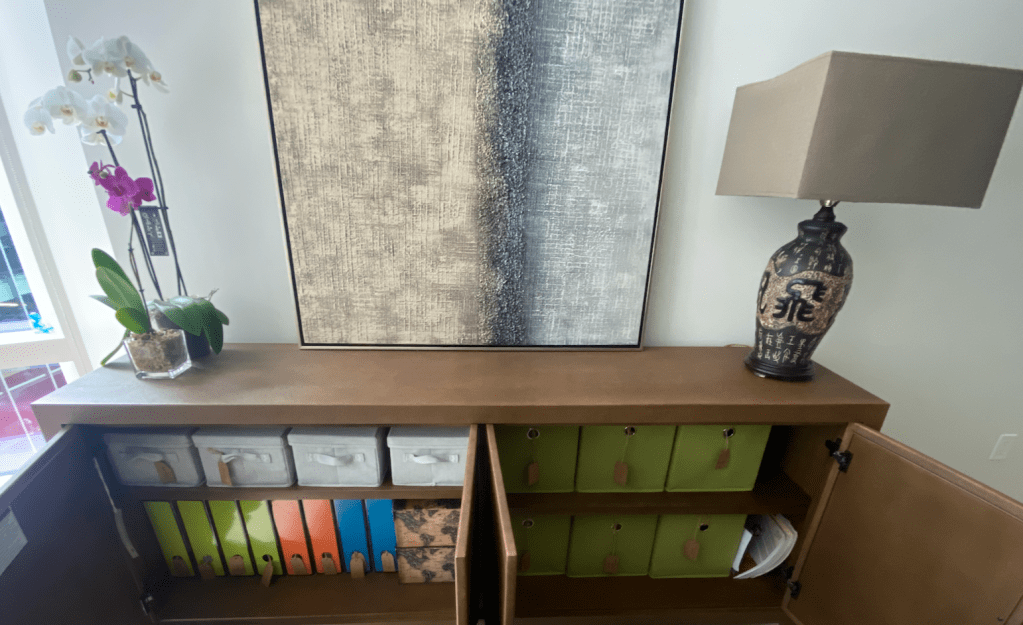
To lessen the visual impact, I organized piles of stuff that went together and then reboxed. I started to think clearer. My inner engineer took over. I acknowledged that my calculations did not account for a reduction from 4 closets to 2, 10 cabinets to 4, and so on. Remediation was obvious. I measured the boxes and calculated the square footage. I found two pieces from Restoration Hardware that totaled the boxed square footage last Sunday and ordered. The furniture arrived on Thursday and by Friday evening, sanity returned to my world. I am back to Feng Shui nuances and over cleaning.
I do recognize I may be an extreme case. The knowledge of what impacts me does not mean I avoid or don’t encounter these experiences; to the contrary. It helps me understand what has a negative impact on me and permits me the clarity, as Tara Nicole Kirke would say, to take the natural next step. This week, self reelect. What makes you lose your mojo3, your magic, your ability to function normally?

1What Is Swedish Death Cleaning? How the Method Can Help You Declutter
2Marie Kondo explains Spark Joy
3“Mojo” originally referred to a kind of magical charm or amulet of African origin.
 Balancing on Unstable Surfaces
It looks great now!
LikeLike