
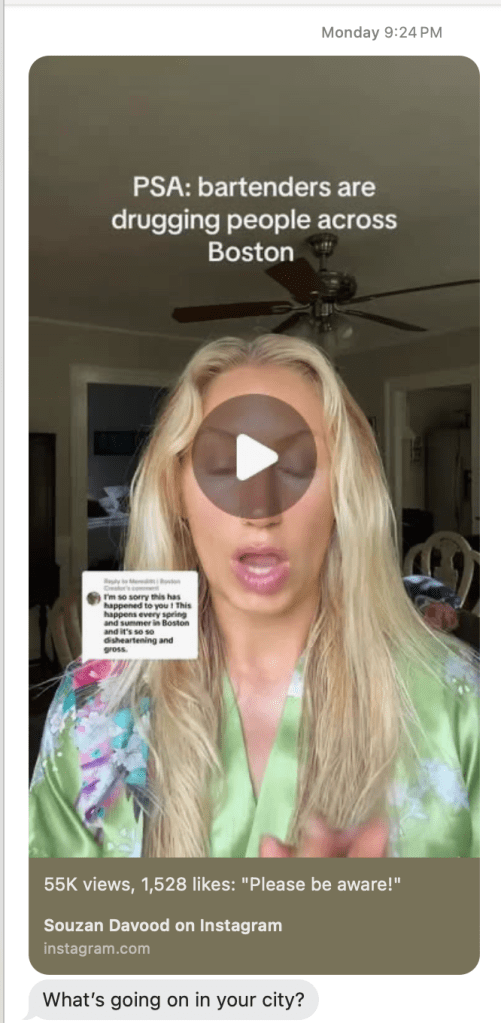
A friend sent me an Instagram post about drugged drinks in Boston, so I thought, is this real—can I write about it? I talked to bartenders who confirmed “spiked drinks” are an issue here in Boston. Bingo. I have content and perspectives for both this blog post and a Substack article.
I found out entire teams of bar staff have been fired over drugged drinks here in Boston. Some bartenders keep a “list” of safe bars for when tourists ask for recommendations.
My head spun. Local magazine and newspaper articles focus on contingency and mitigation. The contingency: if you suspect your drink was spiked, act immediately. Get to a safe situation. Make sure you report the incident to the establishment and the police. That’s a lot to remember and do when you’re half out of your mind from a drugged drink.
For mitigation and prevention. Keep your drinks covered, test your drink with strips that change color. Products like nail polish and straws that change color have yet to be made commercially available. California has a law that went into effect on July 1, 2024, requiring all bars with a 4B license to provide testing devices. Yes, the issue is that widespread.
The root cause? Bartenders are offered a tip to spike a drink, and the drinks are used to facilitate date rape or robbery. Then there are the few cases where it just happened, because they could. For the most part, everything is in place for mitigation and contingency. What about root cause?
Tennessee has new legislation going into effect on July 1st making drink spiking a Class B felony. The earlier proposal also required bars to provide drink covers. A strong message of problem-solving and an equitable solution would combine both: penalize the perpetrators at the root cause, and mitigate with drink covers and test strips. That was not to be.
Since the drugs metabolize so fast, detection after ingestion doesn’t do much. GHB and Ketamine must be tested in urine within 12 to 24 hours. Blood tests are effective between 8 and 12 hours. With standard screens, the window is only 1 to 2 hours. In emergency rooms, if any test is administered, it’s only the standard screen—insurance costs, you know.
You can’t really test for it, camera footage rarely shows anything, and some of comments from the instagram post, are rather. This is messed up. Is this a defeatist attitude, or just reality?
Research shows that 85% to 90% of drink spiking incidents go completely unreported to authorities. Victims most commonly cite a lack of clear memory of the event, distrust in police follow-through, or a belief that “there is no point” in coming forward.
I don’t have an answer, perspective, or even an approach. I recommend the Facebook group, Booze in Boston. I want people, particularly women, to be on alert. This week, when I’ve mentioned this, I’ve been met with either “I haven’t heard anything about this” and a look like I’m making stuff up, or a “but why,” seemingly another effort to distract from what sounds to me like a true issue. And maybe that’s part of the problem: disbelief versus what can we do to help.

