“Since Reconstruction.” Those words were on repeat after the recent midterm elections. What does that really mean? To call the wins and flips, particularly in the Southern states, historic ignores history. If the phrase “since Reconstruction” were replaced with the more historically accurate “since Jim Crow,” a more honest conversation could be had.

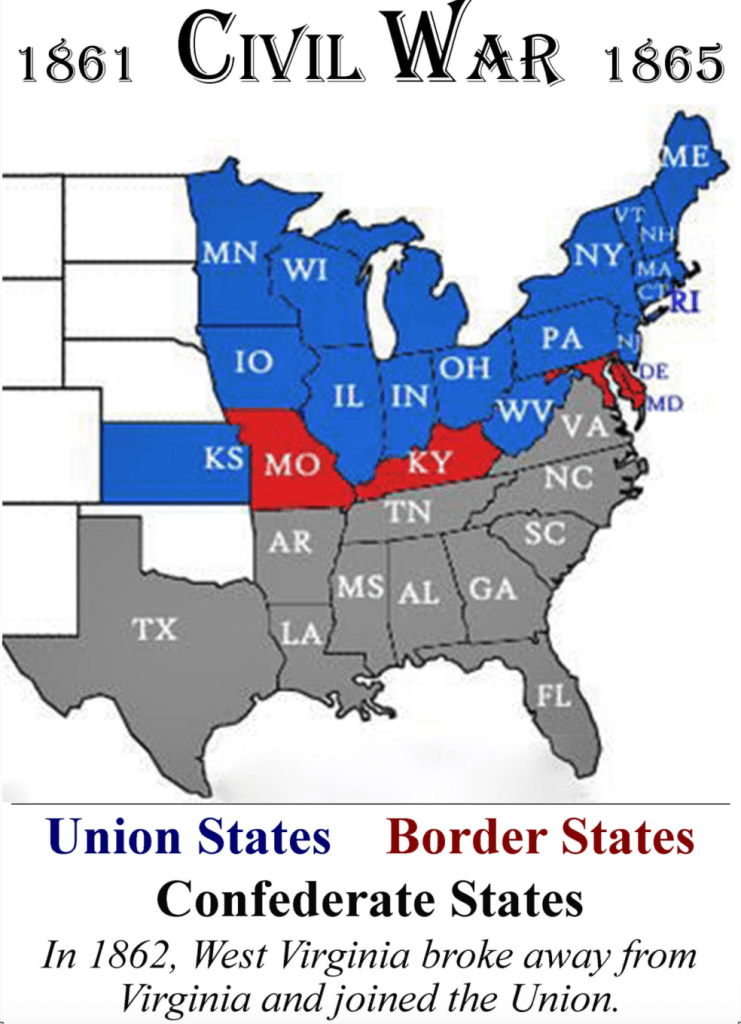
Following the Civil War, eleven Southern states that had seceded from the Union (i.e., declared themselves no longer part of the United States of America) were reintegrated (an ironic word choice) back into the United States under conditions that guaranteed legal, political and social status for newly emancipated African Americans.
One hundred years prior to Reconstruction, the three-fifths compromise in Article I, Section 2 of the U.S. Constitution declared that, for the purpose of counting state populations for congressional representation (in the House of Representatives) and direct taxation, each enslaved person would be counted as three-fifths (60%) of a person.
Southern states wanted to count their entire enslaved population to increase their political power in Congress, while Northern states wanted to exclude them. The three-fifths ratio was a political compromise to break the deadlock and secure ratification of the Constitution. Reconstruction nullified this compromise with the ratification of the 13th Amendment (which abolished slavery) and the 14th Amendment (which mandated counting all persons in the census).
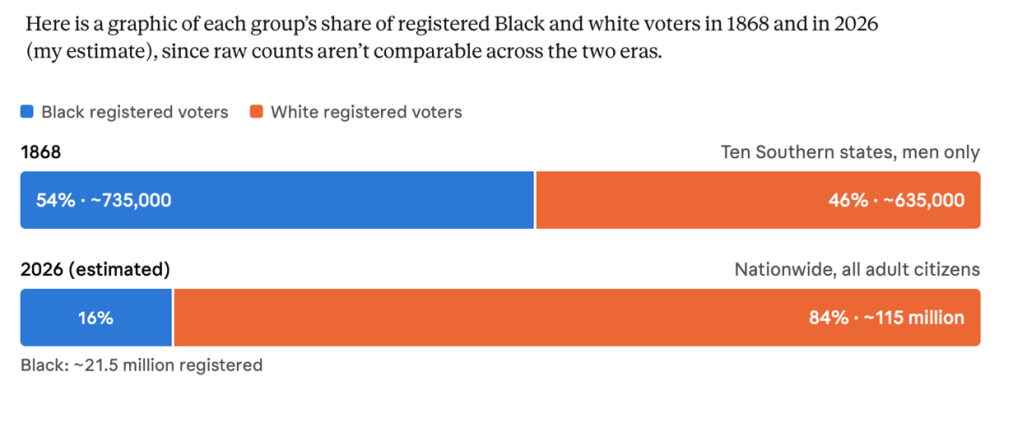
In 1868, African American registered voters outnumbered European American voters. During Reconstruction, in the ten Southern states that had seceded, African Americans held two Senate seats, 14 House seats, and 1,485 elected state and federal positions.
Historically, during Reconstruction, African American representation in the House of Representatives was 2.4%. After Jim Crow, that number was not reached again until 1969, after the Voting Rights Act, a hundred years later. Jim Crow laws were the backlash to equality for African Americans.
Jim Crow was a state-enforced system of racial segregation and white supremacy in the United States that operated primarily in Southern and border states from the late 19th century until the mid-1960s.
Key Aspects of Jim Crow
The Jim Crow Laws: State and local statutes mandated the complete separation of Black and white Americans in public life, including schools, transportation, restaurants, water fountains, and hospitals.[“Separate but Equal”: The U.S. Supreme Court decision in Plessy v. Ferguson (1896) legalized these discriminatory practices by ruling that racial segregation was constitutional as long as separate facilities were “equal”—though in reality, facilities for Black Americans were consistently neglected and inferior.
Voter Disenfranchisement: White-dominated legislatures used literacy tests, poll taxes, grandfather clauses, and intimidation to strip African Americans of the right to vote.
Systemic Violence and Enforcement: The caste system was backed by police complicity, rigid social etiquette codes, urban race riots, and thousands of lynchings carried out by white supremacist groups like the Ku Klux Klan. You can explore the historical structure of these mechanisms through the Jim Crow Museum and America’s Black Holocaust Museum.
Origin of the Name
The term “Jim Crow” did not refer to a real person. It originated from “Jump Jim Crow,” a 1828 song and dance routine performed by white actor Thomas Dartmouth “Daddy” Rice in blackface. Rice used the caricature to mock Black people, and the name eventually evolved into a derogatory epithet and a symbol for the entire era of legal racial subjugation.End of the Era
The Jim Crow system was gradually dismantled through legal challenges—such as Brown v. Board of Education (1954), which ended school segregation—and mass mobilization during the Civil Rights Movement. It was legally terminated nationwide by federal legislation: the Civil Rights Act of 1964 and the Voting Rights Act of 1965.
The two Trump administrations seem to be a backlash against the Obama presidency. The Trump administration began systematically dismantling the Voting Rights Act of 1965 by gutting the Department of Justice (DOJ) Civil Rights Division (70% cuts), limiting the government’s ability to investigate and prosecute election discrimination. The DOJ dropped federal cases targeting racial discrimination. Landmark Supreme Court cases that sought to prevent redistricting were withdrawn. Once the Supreme Court ruled in Louisiana v. Callais, Section 2 of the Voting Rights Act became harder to prove. All of this gave way to Texas gerrymandering its maps to benefit Republicans at the request of President Trump. Per the election results, that did not go well.
Congratulations to Scott Colom on his win. One of the political ads, “Pick Another Senator,” was absolutely brilliant. As we move forward, I have hope that there will not be another backlash, but another way. Can’t we all get along?