

“Living in a Bubble” refers to being oblivious to external realities or confined within a narrow, self-centered viewpoint. People start with, “I know I live in a bubble to express opinions. ” So, attention Bubble Heads, stop it. Use your words and acknowledge the perceptive you think your bubble has. I had a friend who recently did that, described what she thought was her bubble and there I was to bust that little white lie.

It was at dinner in Manhattan this week. I asked my friend, “Look around the room, do you see it?” “Oh yes,” she responded enthusiastically, “it is really crowded for a Tuesday evening; this place is packed.” I was surprised she missed something so obvious to me, I rephrased, “Look at the clientele.” She shrugged her shoulders while she looked around and replied, “other than being packed at 7:00 on a Tuesday evening.” I chuckled, shook my head, and said, “Except for the two of us and one woman at the table on the right, it’s all men, and with the exception of me, it’s all white.” With gusto, she said, “Oh, you’re right. You know, this would never happen in the Bay Area, but we’re in a bubble there, we’re diverse.” I went into social scientist, data analytic mode, “If you don’t notice it here, you probably have been in the same situation in California and not noticed. I can tell you, it happens a lot there [in California].” (As far as diverse cities are concerned, New York is #6, while from the ‘Bay Area,’ Oakland is #27 and San Francisco is #162.)
To say, “I know I live in a bubble,” is akin to a little white lie. Most likely, you’re either missing something or people are not speaking up in opposition. I’ve had three events in the last year where I thought those present were in agreement with me only to have them express a diametrically opposed view. One was discussion was around a divorce where the man was gay. I was happy and supportive while the opposed opinion was that he should have shut up and kept the family together. Yes, obviously, I’m stubborn in my view. The point is, I could say, yes, I am in a bubble where people accept 10% of the population, but that would be a little white lie.
People feel more emboldened to tell me what they really think. As a female minority over the age of 65, perhaps that’s because I’m viewed as a throwaway. Someone powerless who doesn’t have an impact. You know, like when there are all kinds of private conversations going on while people are getting their mani-pedis, as if the workers can’t hear and understand what is going on.
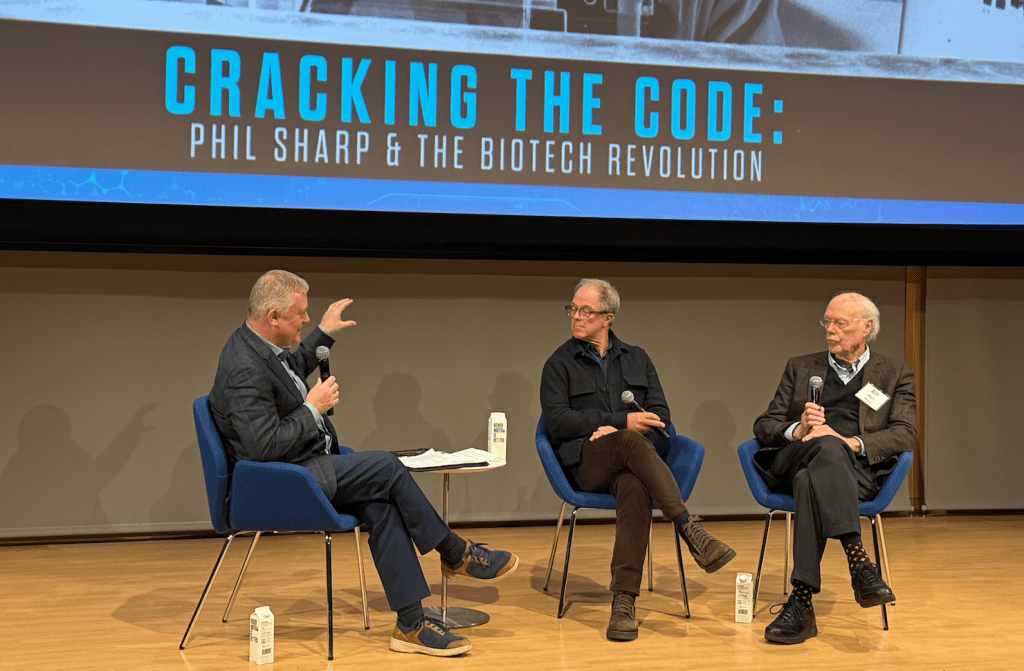
We gravitate to be in environments that support our beliefs. I’m in piano classes, we’re diverse in race, age and gender. However, it is extremely unlikely there will be someone who hates music in the group. I don’t recall I’ve ever said, I’m in a bubble though. I’m known to say, I’m with my people. Friday I attended a screening for Cracking the Code: Phil Sharp and the Biotech Revolution. I was with my people, DNA sequencing, research and RNAi. I got to meet a Nobel Prize winner, he autographed my book and I had a lot of laughs in a full conversation with his wife. The evening and recent Boston Globe article reminded me of the other bubble.
The Boston biotech bubble surged during the COVID 19 pandemic. Economic bubbles happen, but this is a new kind of diabolical. The current administration’s attack on the colleges in the area, and the immediate reduction of funding has tanked biotech, medical research, the local economy and the future of medicine. Yes, we have always had boom, bust cycles, railway, oil, housing, telecommunications, but have any happened because of a surgical strike by the White House?
The lasting effects of Boston’s biotech brain drain
Funding cuts in biotech and biomedical research create generational wound
Massachusetts attracts scientists and researchers from across the world as a hub of biotech and biomedical research, but funding cuts enacted by the Trump administration, along with severe immigration policies, have changed that attraction to repulsion.
Those same leaders in biomedical research are now relocating or changing careers altogether, searching for funding, stability and safety.
A prominent cancer scientist is uprooting his Harvard University lab of two decades and moving it to Texas. A laid-off expert on aging abandoned academia for a more secure municipal research job in New York City. And a women’s health researcher, exhausted by the churn of immigration policies, made the wrenching decision to start over in Canada.
Their departures illustrate a sobering new reality: The Trump administration’s research funding cuts, abrupt policy shifts, and crackdown on immigration are driving a brain drain that threatens Massachusetts’ standing as a global hub of biomedical research, its economy – and the fight against major diseases such as childhood cancers, Alzheimer’s, and sickle cell.
Massachusetts research institutions lost between $47 million and $100 million in NIH funding last fiscal year compared to the year before, according to analyses by the Massachusetts Biotechnology Council and STAT, the Globe’s sister publication.
As a result, the Northeast had the most clinical trials disrupted out of any region in the country, one study showed. In Massachusetts, NIH funding disruptions affected at least 13,000 patients and 18 clinical trials on conditions including colon cancer, pregnancy complications, and strokes, according to a letter Governor Maura Healey wrote to Health Secretary Robert F. Kennedy Jr. last month to demand he restore all funding.
…So a lot of the funding was restored, but a lot of these scientists ended up having to let go of their young researchers, ‘cause they couldn’t rely on it. So their studies have been stalled. They don’t know what’s gonna happen next year. Some scientists likened it to the Sword of Damocles, so they say you can’t just stop funding and then just receive it again and resume where you were. People’s lives have moved on and so they’re in a still, many of them feel like they’re in a state of limbo. The Trump administration is so mercurial. One minute, the Trump administration is about to sign a deal with Harvard. The next minute, they’re not, so it’s very difficult to plan.
The lasting effects of Boston’s biotech brain drain
Funding cuts in biotech and biomedical research create generational wounds
By Jazmin Aguilera, Sarah Rahal and Jonathan Saltzman
Are people telling themselves little white lies when they claim the current administration isn’t causing significant harm? Are these just small untruths or variations of “I live in a bubble,” serving as shortcuts in language to avoid facing reality? Take, for instance, the little white lie of living in a “bubble,” despite the evident lack of diversity in the restaurant. There’s the misleading notion that budget cuts won’t have lasting effects when 13,000 patients in the state are no longer part of clinical trials, coupled with the departure of medical researchers. This week, reflect on these little white lies. Are there comforting narratives you tell yourself, or are there truths you find unbearable to confront?
 Balancing on Unstable Surfaces
Chilled, disappointed and angry. Hope is harder to come by these days
LikeLike