

“But I saw it.” That justification of fact is weakened online in the time of AI. Should we say, “I saw it and I believed it to be true,” rather than “I saw it?” Whilst I am a big supporter of AI, I am also an advocate for verification. I watched a video this week that described new airline carry on rules for 2026. Then I went in search of a website or article that would list all the changes I just viewed. There was none to be found. Still curious, I used Perplexity (a ChatGPT competitor.) Voila, I had a list in a nice table format of everything I heard in the video…except, Perplexity sited the source and the source was the YouTube Video I’d watched for everything other than the change in liquids allowed.

We’re all aware that photos can be doctored. In March 2024, the Associated Press (AP) issued a “kill” notice for a royal family photo distributed by Kensington Palace, effectively declaring it an unreliable source for this specific image due to evidence of digital manipulation which included a superimposed image of the princess from a vogue cover that was 8 years old. This led other major news agencies like Reuters, AFP, and Getty Images to follow suit.


These manipulate images or deepfakes typically serve to either reassure, provoke outrage and alarm. The image of the princess was to reassure came out on March 10, 2024. Catherine had other been seen publicly since her “planned abdominal surgery in January of 2024. There is also a third category, humor. There is the infamous “photo” of Pope Francis in a Balenciaga puffer coat. OK, for a few who believed this to be true, it did spark outrage.
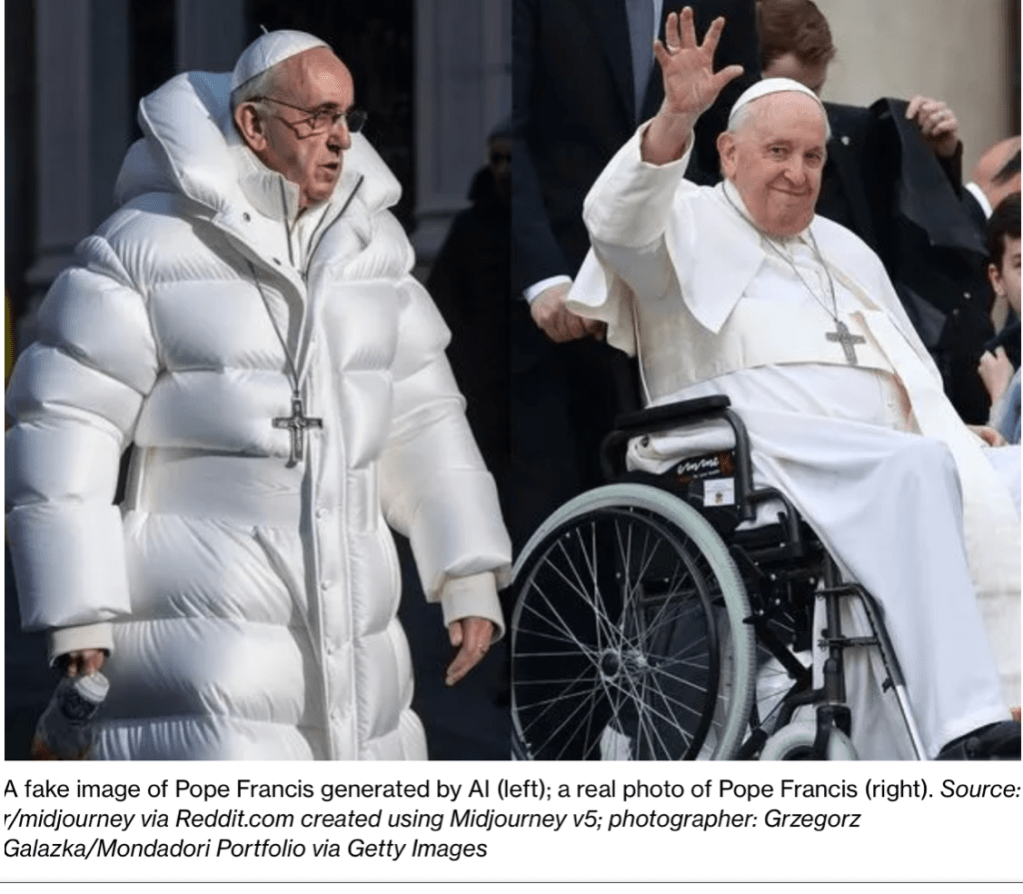
It’s kind of funny how the first line of defense with something like these photos or videos is, “but, why would someone do this,” rather than pursue a line of logic. Things like videos, content creator are monetized by views. Hence you can get misleading headlines that make your click. The content can do things like create alarm that incentivize you to buy certain products. Not to have you question everything, just be aware. When I did try the additional source links Perpelixity provided for the “new rules,” I got Norton pop up warnings for unsafe site. So back to the why, these are a way to capture your data. There are a few things to consider, from ChatGPT
ChatGPT
- Source
Who posted it?
Is the website or account reputable?- Evidence
Is there proof?
Can you find the same info on other trusted sources?- Date
Is the info recent, or is it old content being reused?- Emotions
Does it try to make you very scared, angry, or excited?- Quality
Spelling/grammar errors?
Overly dramatic headlines or ALL CAPS?- Images/Videos
Look for visual glitches or signs of editing/AI.
Reverse-image search if unsure.- Account Verification
New or suspicious-looking account?
Few posts or weird username?- Too Perfect?
Does it fit your beliefs too neatly? Be cautious.
The first item explains why AP issued a kill notice for the family portrait. Sources want to remain reputable. The second item is what I did with the airlines. I often look for proof for many things I see on YouTube. Let’s talk about item 6. Look for the glitches. To date, AI cannot do text and hands in images. The fingers look off. Look at the Pope in the Puffer, the fingers on the hand with the water bottle are off. The family portrait, Louis fingers on the table are are off.
Recall the stories of when people first saw “the moving pictures” they thought the train was coming directly towards them and they screamed and jumped out of the way. We can easily laugh at that now or when we see older movies with their obvious special effects. We’re in a space now where we don’t notice the stunt doubles, green screen action and stock footage, in film. What’s key is, if these actions led us to believe something is true that isn’t. The movie The Program featured a scene where college football player lays down on the divide line of a highway to prove his bravery. Tragically, teens tried resulting in death in one instance and injuries in many others causing the scene to be deleted from the film.
“But I saw it.” Is seeing believing or AI? This week, notice when and how you accept something as true.
 Balancing on Unstable Surfaces
Great points!
I typically query Claude, Chat GPT and now Gemini (I just dropped the Perplexity subscription) for any query. If they are not in alignment on results, that’s a red flag to indicate that an independent deeper dive is needed.
A recent experience in which it took over 150 interactions with Claude to correctly generate a Gantt chart from a spreadsheet (which required code troubleshooting from ChatGPT, as well as my nascent HTML coding skills from the days of IBM Script) informed me that the Great AI Takeover may not be as imminent as once suspected.
And Happy Thanksgiving to you and your brother, Sheila Penelope!
LikeLike