
Interview with the Vampire
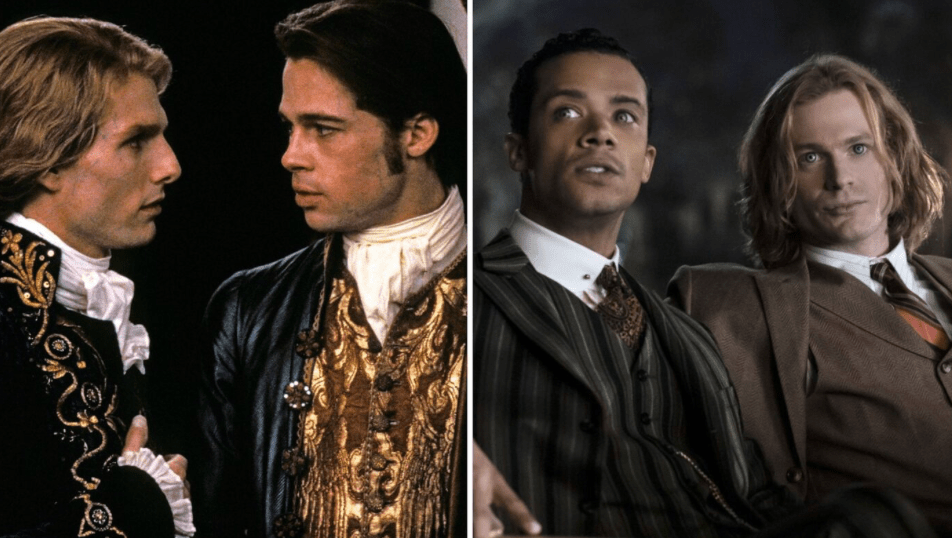
II love Interview with the Vampire — AMC’s Interview with the Vampire, not the 1994 movie with Brad Pitt and Tom Cruise, but the TV show with Jacob Anderson and Sam Reid. The actors, the writing, the sets, the clothes — humor and horror in equal measure, with a pinch of camp and Southern Gothic. The series is a clear departure from the book and yet true to its source at the same time. It’s based on the books by Anne Rice and adapted by showrunner Rolin Jones.
Having read a number of Anne Rice’s own comments on adaptation, I’d guess she would have been less than thrilled with this production. She insisted that adaptations stay faithful to what she’d written. By the time the television rights reverted to her, she envisioned a series in the vein of Game of Thrones. Then again, to get the movie made, she was willing to rewrite the role of Louis as a woman to “heterosexualize” the character, with Cher in mind for the part. Anne Rice voiced opposition to the cast of the 1994 movie. Ultimately, once she saw it, she loved it — I mean, loved it! While she’d initially compared casting Tom Cruise as Lestat to casting Edward G. Robinson as Rhett Butler, after viewing the movie she apologized to Cruise and even took out a two-page ad in Variety to praise him and the film. So maybe there’s a slight chance she would have liked AMC’s adaptation? Nah, I think not.
As for AMC’s production, Jones moved the timeline forward by a century. Louis, played by Brad As for AMC’s production, Jones moved the timeline forward by a century. Louis, played by Brad Pitt in the 1994 film, is now a Creole man navigating Jim Crow–era Louisiana. Claudia, five years old in the book, is now fifteen. Our vampires navigate Europe during World War II. I could go on, but the best description is that it’s a series crafted to serve the demands of serial television while telling a story that feels timely for today’s audience. Rolin Jones’s vampires resonate with a certain type of vampire fan today — maybe those of us who grew up watching Dark Shadows, devoured the Anne Rice books, and were never particularly interested in the Twilight business.
My Vampire Week
So, I’m done. I rewatched the first two seasons of Interview with the Vampire, along with its most recent season, The Vampire Lestat. Both are brilliant — though maybe that word only carries weight for those of us in the cult following. This is a series that forces a moratorium on other streaming and bingeing, because nothing else compares.
Not the two films — Interview with the Vampire and Queen of the Damned — nor the one Broadway adaptation, Lestat. It did a pre-Broadway run in San Francisco with one of the best taglines: “die young, live forever.” Elton John did the music. For me, it was so bad I stayed only because I kept expecting it to get better. It didn’t. It closed after just over a month. Ms. Rice praised the performance. This makes me ponder the impact of artistic license on the source artist — something along those lines.
Anne Rice’s vampire universe spans books, movies, a TV series, and a Broadway production — a little like Wicked.
Wicked: The Same Story, Several Times Removed

L. Frank Baum’s The Wonderful Wizard of Oz was widely read as an allegory for the American Populist movement when it was published in 1900 — the yellow brick road representing the gold standard, the (originally silver, later “ruby”) slippers standing in for silver currency, and even the name Oz echoing the abbreviation for “ounce,” the unit used to measure gold and silver. A children’s fairy tale on the surface, with a deeper meaning underneath. The book became the classic movie musical released in 1939.
In 1995, Gregory Maguire published Wicked: The Life and Times of the Wicked Witch of the West, an allegory for totalitarianism, state-sponsored propaganda, and the systematic persecution of minority groups. Maguire drew heavily on the Holocaust and the Gulf War, and the novel itself was dark.
The stage adaptation — the musical Wicked — held its San Francisco pre Broadway run in 2003. I was there with my mom and sister-in-law, and it felt like a full-circle moment, having watched The Wizard of Oz with my mom as a child. But I digress. The musical transformed Maguire’s political satire into an uplifting story about female friendship and empowerment. And now there’s the film, based on the musical, based on the novel, which was itself an alternate telling of The Wizard of Oz.
Gregory Maguire initially felt the broadway musical was sort of a bait and switch from the book, Elphaba gets a happy ending, he still feels the core themes of love and forgiveness are there. It will be interesting to see what happens in the most recent saga of Children of Blood and Bone by Tomi Adeyemi. Ms Adeyemi, brought on to cowrite the screen play has distanced herself from the Paramount Pictures movie, stating she will not watch or promote it and describing the behind-the-scenes experience as traumatic.
Whether it’s Wicked or Interview with the Vampire, there’s real distance between the adaptation and the source. But all of it is meant to entertain, provoke, and occasionally thrill. As they say: no harm, no foul. But what happens when this same process is applied to history instead of fantasy?
When the Source Material Is History

Consider 21, about the MIT Blackjack Team, which cast white actors as leads even though the real team was largely Asian American. Or Ben Affleck’s Argo, where Affleck cast himself as Tony Mendez — a Mexican American CIA officer. (Don’t get into The Odyssey‘s casting of Lupita Nyong’o as Helen of Troy, there’s no hard evidence Helen of Troy was a real person at all.) Back to history.
My favorite example: when a studio considered Julia Roberts to play Harriet Tubman, and an executive reportedly said, one studio head said in a meeting:
‘This script is fantastic. Let’s get Julia Roberts to play Harriet Tubman,’” he recalled. “When someone pointed out that Roberts couldn’t be Harriet, the executive responded, ‘It was so long ago. No one is going to know the difference.’” (Deadline, 2019)
Entertainment or Infotainment?
Movies are immersive — similar to how it feels when I finally crawl out of my own vampire lair after a binge. When done well, they give us something like an experience, even if it isn’t quite the real thing. With Vampires and Wicked, we know it’s not a real world. Other things, maybe not so much.
Even so, entertainment has a way of quietly becoming history in the public imagination. Be it fact or fiction, there is an impact. The incidents in the movie Jaws are statistically impossible. Impossible! Yet when Jaws was released in 1975, there was a spike in shark sightings, and tourism for beach vacations dropped. In 1999, with The Blair Witch Project, people sadly thought the events were real and that the students had actually disappeared.
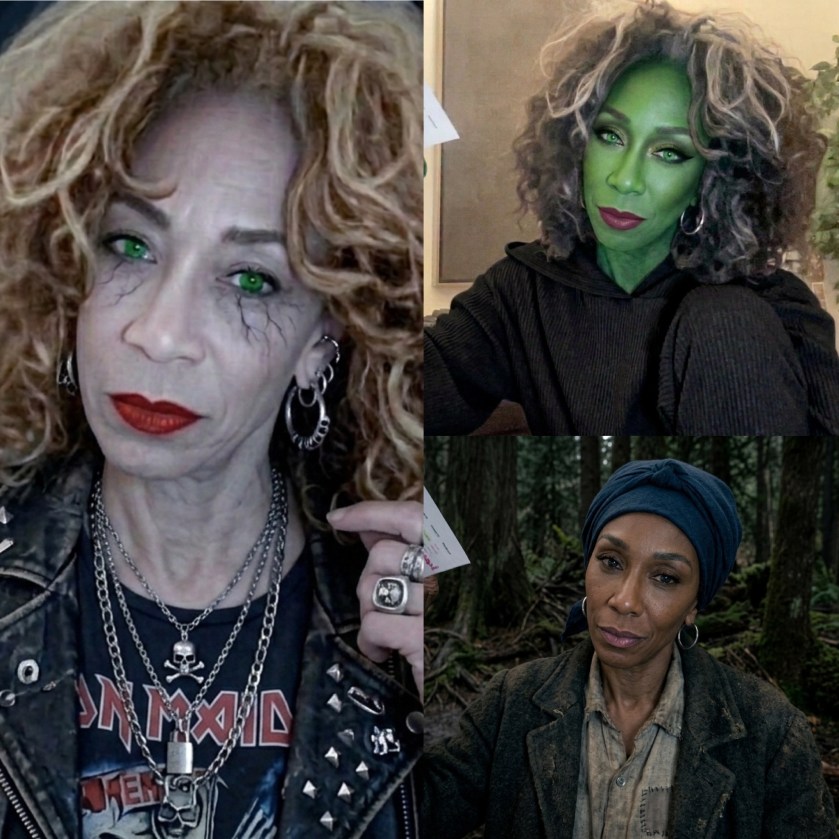
As an audience, what’s our responsibility here — as consumers of entertainment versus infotainment? From a source photo, I can generate images. Is it me? Is it what I am, or what I could be? Or is it just a fantasy?
Note: These images are base on me, not me, AI created subtle changes to bring my face closer to the golden ratio. A little wider forehead, slightly larger eyes. make up, etc. It’s am adaptation of me.
*I wrote about this on Substack

